-
Category 3
Selected in 2025
-
Grades: 9 - 12
School Setting: rural
Town Population: 6
Student Enrollment: 569
Student Demographics:
Black/African American: 0%
Teacher/Student Ratio: 1:25
White/Caucasian: 0%
Hispanic: 1%
Hawaiian/Pacific Islander: 0%
Asian: 0%
Native American: 99%
Other: 0%
% Reduced Lunch: 100%
% ELL Learners: 25%
Founded: 1946 -
PRINCIPAL:
"Dan" William Horsley -
CONTACT:
Navajo Route 12
Fort Difiance, AZ 86504
928-729-7001
williamh@wrschool.net
Window Rock High School
Fort Difiance, AZ

- 1. What key actions or strategies have been most instrumental to your school’s success?
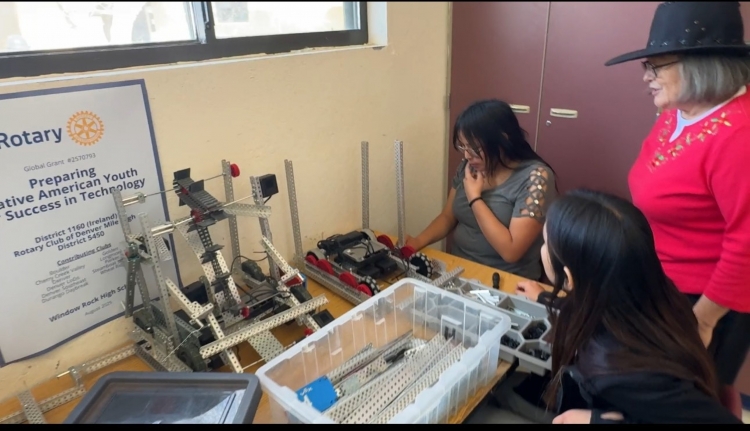
- Window Rock High School’s sustained improvement in academic achievement, graduation rates, and post-secondary outcomes is the result of intentional, data-driven actions that address academic recovery, student engagement, and long-term readiness. The most instrumental strategies include the implementation of a structured 7th-period intervention model, culturally responsive mentoring and ECAP programming, consistent use of high-impact instructional strategies (HIITS) within UDL framework, and collaboration supported by community partnerships. Data demonstrate that these strategies have been particularly effective for ELL students and students receiving special education services. Programs such as GEAR-UP, Navajo Elevate, vocational rehabilitation services, work-study placements, and CTE pathways provide real-world learning opportunities. CTE data highlights WRHS’s strength, including 100% technical skills assessment proficiency and industry credential attainment exceeding state averages.
- 2. What significant challenges did your school face during your improvement efforts, and how did you address them?
- One of the most significant challenges faced by WRHS was the extended closure caused by COVID-19 lockdown procedures on the Navajo Nation. Unlike most Arizona schools, WRHS remained fully remote for the remainder of the 2019–2020 school year and the entire 2020–2021 school year due to a Navajo Nation Presidential order prohibiting students from returning to campus. During this time, approximately 77% of WRHS students did not have access to reliable internet and were forced to rely on instructional packets rather than live or virtual instruction. This created substantial learning gaps, particularly for ELL and ESS students who depend on direct instruction, language interaction, and specialized supports. To address this challenge, WRHS shifted into a full-scale intervention model upon students’ return to campus. The school implemented a 7th-period intervention for all students. This intervention allowed for focused remediation in reading, math, and science aligned to state standards.
- 3. How did professional development contribute to your school’s improvement efforts?
- One of the most significant contributions of professional development at WRHS has been the consistent implementation of high-impact instructional strategies (HIITS) across all classrooms. Through ongoing training rooted in “Teach Like a Champion,” teachers were equipped with concrete, research-based practices such as targeted questioning, checks for understanding, circulate, no opt out, stretch it, everybody writes, and affirmative checking. These strategies were intentionally selected because of their effectiveness in supporting ELL and ESS students while maintaining rigorous expectations for all learners. Professional development sessions focused on modeling, practice, and feedback rather than one-time exposure. Teachers participated in Saturday PD sessions, instructional rounds, and peer-led workshops to refine their use of these strategies. Professional development also played a critical role in helping teachers effectively use data to guide instruction.
- 4. In what ways did family and/or community partnerships support your school’s success?
- Family and community partnerships have played a vital role in Window Rock High School’s (WRHS) improvement efforts by strengthening student engagement, expanding learning opportunities, and reinforcing culturally responsive practices. WRHS recognizes that meaningful school improvement must extend beyond the classroom and be grounded in trust, collaboration, and shared responsibility with families and community stakeholders. Through intentional structures for family engagement, strategic community partnerships, and culturally aligned programs, WRHS has leveraged these relationships to support academic growth, graduation success, and post-secondary readiness for all students, particularly English Language Learners (ELL) and students receiving special education services (ESS). To further strengthen family connections, WRHS established the AFFECT Team (Activating Educators’ Focus on Family Engagement as Central to Teaching), modeled after a program developed by the University of Hawaii.
- 5. How has ESEA funding (e.g., Title I, II, III) been strategically used to support student achievement?
- A primary use of Title I funds has been the staffing and support of Academic Interventionists who work collaboratively with counselors, administrators, and teachers to monitor attendance, credit completion, and academic progress. These interventionists provide targeted support to students at risk of failure or dropout, ensuring timely interventions and personalized pathways to graduation. Additionally, Title I funds have been used to purchase instructional technology and classroom resources, including student laptops and smart boards. These tools ensure equitable access to high-quality instruction and support Universal Design for Learning (UDL) practices that benefit all learners. Technology investments also enable the use of digital platforms such as MI-Write which supports literacy development across content areas. WRHS uses Title II funds to support training in high-impact instructional strategies (HIITS), data-driven instruction, and inclusive practices for ELL and ESS students.
- 6. What advice would you give to a school just beginning its improvement journey?
-
For schools just beginning their improvement journey, the most important advice is to commit to a clear vision grounded in data, relationships, and consistency. Meaningful school improvement does not happen quickly, and it cannot rely on isolated initiatives or short-term fixes. The experience of Window Rock High School (WRHS) demonstrates that sustained progress is achieved through intentional planning, disciplined implementation, and an unwavering focus on the whole student. The first step in any improvement effort is to take an honest look at the data without assigning blame. Schools must be willing to confront uncomfortable truths about academic performance, attendance, graduation rates, and subgroup outcomes. Build structures that support instructional focus. Invest in professional development that changes practice. Be patient, persistent and celebrate growth.
Finally, schools must understand that improvement is a long-term process. Setbacks will occur, and progress may be uneven.
Stats
-
Category 3
Selected in 2025
-
Grades: 9 - 12
School Setting: rural
Town Population: 6
Student Enrollment: 569
Student Demographics:
Black/African American: 0%
Teacher/Student Ratio: 1:25
White/Caucasian: 0%
Hispanic: 1%
Hawaiian/Pacific Islander: 0%
Asian: 0%
Native American: 99%
Other: 0%
% Reduced Lunch: 100%
% ELL Learners: 25%
Founded: 1946 -
PRINCIPAL:
"Dan" William Horsley -
CONTACT:
Navajo Route 12
Fort Difiance, AZ 86504
928-729-7001
williamh@wrschool.net
ESEA Network
The National Association of ESEA State Program Administrators is dedicated to building the capacity of education professionals to provide disadvantaged children with a high quality education. Their ESEA Network website provides a host of resources to educators at all levels.
Connect With Us
 |
 |
 |
 |
Contact Us
admin@eseanetwork.org | 800-256-6452
532 North Franklin Street | Fort Bragg, CA 95437
About Us
The National Association of ESEA State Program Administrators (formerly the National Title I Association) is dedicated to building the capacity of education professionals to provide disadvantaged children with a high quality education. Their ESEA Network website provides a host of resources to educators at all levels.
Connect with Us
|
|
|
|