
-
Category 2
Selected in 2025
-
Grades: k - 5
School Setting: urban
Town Population: 488,000
Student Enrollment: 275
Student Demographics:
Black/African American: 29.6%
Teacher/Student Ratio: 1:20
White/Caucasian: 30.4%
Hispanic: 16.7%
Hawaiian/Pacific Islander: 0%
Asian: 7.8%
Native American: 0.4%
Other: 15.6%
% Reduced Lunch: 70.5%
% ELL Learners: 19%
Founded: 1925 -
PRINCIPAL:
Meagan Bakhit -
CONTACT:
3420 N. 78th St.
Omaha, NE 68134
531-299-1000
meagan.bakhit@ops.org
Adams Elementary School
Omaha, NE
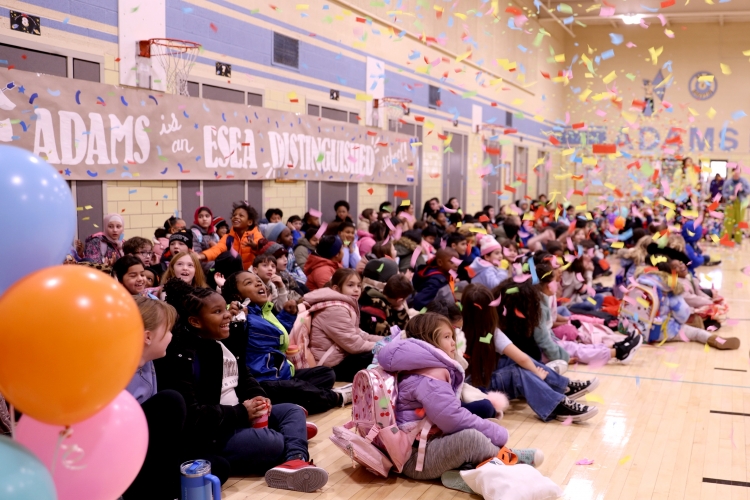





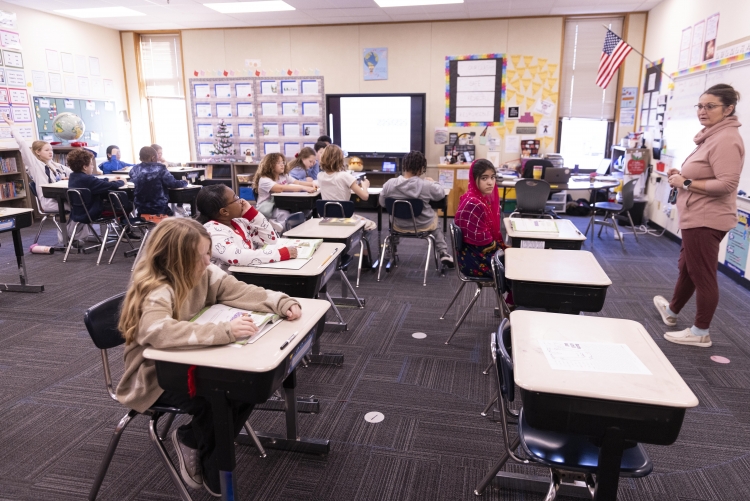

- 1. What key actions or strategies have been most instrumental to your school’s success?
- The key actions that led to our success centered on strengthening Tier I instruction, responding to data with urgency, and establishing high expectations for every learner. We implemented consistent, evidence-based literacy routines, aligned phonics instruction, and explicit language supports that accelerated growth for our EL and Special Education students. PLCs engaged in frequent subgroup data analysis to adjust instruction and target essential skills with precision. Our leadership team reinforced this work through coaching, low-inference observations, and ongoing professional learning. By combining strong core instruction with intentional scaffolds, clear learning goals, and a shared belief in every student’s potential, we increased proficiency, exceeded growth goals in targeted subgroups, and built a school-wide culture of academic ownership.
- 2. What significant challenges did your school face during your improvement efforts, and how did you address them?
- Our improvement efforts began during the 2021–2022 school years, when we faced unprecedented staffing instability, vacancies, and prolonged absences due to COVID. Students returning to full-time school also required significant reteaching of expectations, routines, and social skills, and behavior referrals reached an all-time high. We addressed these challenges by unifying as a team, rebuilding consistent Tier I systems, and strengthening SEL and behavior supports. At the same time, I worked intentionally to bring FUN back to school—celebrating growth, creating joyful traditions, and reminding staff and students that school is a place of connection and belonging. Reestablishing joy, stability, and high expectations allowed us to regain momentum and accelerate both academic and behavioral growth.
- 3. How did professional development contribute to your school’s improvement efforts?
- Professional development played a central role in our improvement efforts. We prioritized training on academic conversations and explicit language supports to strengthen engagement and access for our EL learners. Teachers also deepened their use of high-impact engagement strategies designed to shift the cognitive load from teacher to student and increase active participation in Tier I instruction. In addition, our K–3 staff engaged in intensive Science of Reading professional learning, developing a strong understanding of the foundational skills required to build proficient readers. These learning experiences created alignment, strengthened instructional practice, and directly contributed to the academic gains and gap closure our students achieved and continue to experience.
- 4. In what ways did family and/or community partnerships support your school’s success?
- Our strong family and community partnerships were essential to our success. Adams families consistently show up—volunteering at literacy nights, supporting family engagement events, and assisting teachers with instructional preparation. These partnerships created a shared investment in learning and reinforced the value of education beyond the school day. We also worked intentionally to strengthen communication, increase opportunities for meaningful involvement, and build trust with our families. Community partners supported enrichment, resources, and celebrations that helped sustain motivation and belonging. Together, these relationships amplified our efforts, supported consistent attendance and engagement, and contributed significantly to our academic growth.
- 5. How has ESEA funding (e.g., Title I, II, III) been strategically used to support student achievement?
- ESEA funding has been used intentionally to strengthen Tier I instruction and ensure every student has access to high-quality literacy experiences. Title I supported the implementation of research-based literacy materials, school-wide access to evidence-aligned literacy apps, and community engagement events designed to build motivation and excitement around reading. Funds were also used to secure interventionists and an instructional facilitator, allowing us to provide targeted support, coaching, and data-driven instructional adjustments. Title I funding further enhanced professional learning and resources that improved instruction for multilingual learners. Together, these investments created a coherent system that raised student achievement, accelerated growth, and increased connectedness.
- 6. What advice would you give to a school just beginning its improvement journey?
- If you are just beginning your improvement journey, start by grounding your team in belief—belief in students, in one another, and in the collective capacity to grow. Establish clear, high expectations and a shared vision for what success looks like. Build systems that focus on strong Tier 1 instruction, consistent PLC practices, and data that informs—not punishes. Celebrate small wins to build momentum, and create structures for frequent collaboration, reflection, and feedback. Most of all, invest in relationships and culture. When staff feel supported, students feel seen, and the community feels connected, meaningful improvement follows.
Stats
-
Category 2
Selected in 2025
-
Grades: k - 5
School Setting: urban
Town Population: 488,000
Student Enrollment: 275
Student Demographics:
Black/African American: 29.6%
Teacher/Student Ratio: 1:20
White/Caucasian: 30.4%
Hispanic: 16.7%
Hawaiian/Pacific Islander: 0%
Asian: 7.8%
Native American: 0.4%
Other: 15.6%
% Reduced Lunch: 70.5%
% ELL Learners: 19%
Founded: 1925 -
PRINCIPAL:
Meagan Bakhit -
CONTACT:
3420 N. 78th St.
Omaha, NE 68134
531-299-1000
meagan.bakhit@ops.org
ESEA Network
The National Association of ESEA State Program Administrators is dedicated to building the capacity of education professionals to provide disadvantaged children with a high quality education. Their ESEA Network website provides a host of resources to educators at all levels.
Connect With Us
 |
 |
 |
 |
Contact Us
admin@eseanetwork.org | 800-256-6452
532 North Franklin Street | Fort Bragg, CA 95437
About Us
The National Association of ESEA State Program Administrators (formerly the National Title I Association) is dedicated to building the capacity of education professionals to provide disadvantaged children with a high quality education. Their ESEA Network website provides a host of resources to educators at all levels.
Connect with Us
|
|
|
|