
-
Category 1
Selected in 2023
-
Grades: pre k - 5
School Setting: rural
Town Population: 546
Student Enrollment: 118
Student Demographics:
Black/African American: 0%
Teacher/Student Ratio: 1:16
White/Caucasian: 53%
Hispanic: 0%
Hawaiian/Pacific Islander: 0%
Asian: 0%
Native American: 47%
Other: 0%
% Reduced Lunch: 51%
% ELL Learners: 0%
Founded: 1908 -
PRINCIPAL:
Jeff Nemecek -
CONTACT:
800 Bayberry St.
Kadoka, SD 57543
605-837-2171
jeff.nemecek@k12.sd.us
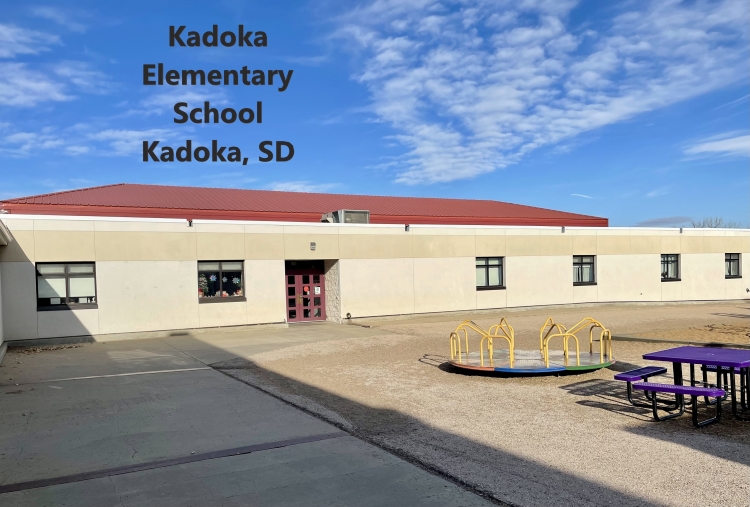
Kadoka Elementary School
Kadoka, SD
We believe that the number one resources in our district are the people.
- 1. Tell us about your school’s success.
- Kadoka Elementary School has an experienced staff that focuses on building relationships first and foremost. We believe that student successes come from family/community support along with every layer of support within the school district. These layers include our custodial staff, kitchen staff, bus driver and monitor, our paraprofessional/support staff and our certified staff. Without the support and hard work of each layer, our students wouldn't have the successes that they have. Our students are also extremely hard working and dedicated to improving themselves no matter where they are at in their learning journey. The team focuses on rigor of the content taught, helping students to think critically about the content, and assessing the needs of the students using multiple means to ensure that each student's needs are being met. Knowing that the content needs to be important to the students, our staff puts emphasis on how the content can be presented to make it important to students.
- 2. Talk about the greatest contributing factor(s) that promoted positive change in your school.
- The Kadoka Area School District has amazing parent and community support. Having this support has been a key factor to the schools successes. Kadoka Elementary School has a great MTSS program that is supported by all staff. With such great focus on meeting student needs both academically and behaviorally, the staff has the ability to maximize instructional time with their students. Through our PLT meetings and effective communication with certified staff, our support staff knows the needs of each student that they help service. We also have a great PBIS program that helps us focus on preferred behaviors instead of putting focus nonpreferred behaviors. These successes wouldn't be possible without staff buy-in. Finally, much of the growth we are seeing now is due to the implementation of a Junior Kindergarten program that was created and developed 10 years ago. Having two years to master kindergarten standards has given students the foundation necessary to be successful moving forward.
- 3. How has ESEA funding supported the school's success?
- We believe that the number one resources in our district are the people. Programs and curriculum that meet state standards are important. Technology is important also. But if we don't have the best people in place to present the materials, then we know that student learning won't be maximized. ESEA funding has allowed us to employ staff that helps us to exceed the standards. Another key element in our successes that stem from ESEA funding are the opportunities to involve parents and community in educating our students. Finally, ESEA funds have assisted with the ability to provide our staff with effective professional development opportunities to sharpen their skills and add tools to their toolbelts.
- 4. What professional development activities were used to improve teaching and learning?
- We have placed high value on bringing in professional development opportunities that focus on best instructional and assessment practices. We team up with Technology In Education (TIE) to bring in professional development opportunities with focus on instructional practices that may include technology supports. We also have a district created Professional Development menu that is accessible with a QR code to staff at any time to find online professional development opportunities of their choosing that best meets their individual needs. During our full day in-service in January, we bring in a motivational speaker to help staff with building positive morale. In the past few years we have had Clint Pulver and Damon West to name a couple. These speakers not only spoke to students and staff, but to parents and community as well. Finally, we utilize each other to model some best instructional/formative assessment strategies that have proven effective within our classrooms.
- 5. Talk about the cultural shift leading up to your school's success.
- The cultural shift leading up to Kadoka Elementary's success seemed to stem from the addition of the Jr. Kindergarten program, which was implemented during the 2013-14 school year. The buy in from staff, parents, and the community for the additional focus on early childhood education took a couple of years to develop, but the need was great and having the additional year to master kindergarten standards and foundational skills at a slower rate has proven to be successful with our students. Seeing the difference that the Jr. Kindergarten program was having with student readiness as well as skill development, we really started seeing our district and state assessment scores begin to shift in an upward direction. Having this program also allowed our MTSS program to flourish and put much needed focus on students in grades 1-5 who needed additional supports to fill gaps. With great buy-in and support from all stakeholders, our student growth has continued!
- 6. How has community involvement strengthened your success?
- Community support and involvement is vital to students feeling supported in academics and extra-curricular activities. Our parent'/community involvement activities are very well attended, which helps students to see that they are supported from the community as a whole. Our 21st Century Afterschool Program brings in community members to lead activities and takes our students out into the community to help with projects and build relationships with our businesses and with all of our stakeholders. The school's partnership with the Afterschool program give's our students great enrichment opportunities and extension opportunities to keep student focused on learning throughout the calendar year. Getting our students out into the nursing home, the county library and into the businesses throughout the community has definitely played a role in our academic success.
Stats
-
Category 1
Selected in 2023
-
Grades: pre k - 5
School Setting: rural
Town Population: 546
Student Enrollment: 118
Student Demographics:
Black/African American: 0%
Teacher/Student Ratio: 1:16
White/Caucasian: 53%
Hispanic: 0%
Hawaiian/Pacific Islander: 0%
Asian: 0%
Native American: 47%
Other: 0%
% Reduced Lunch: 51%
% ELL Learners: 0%
Founded: 1908 -
PRINCIPAL:
Jeff Nemecek -
CONTACT:
800 Bayberry St.
Kadoka, SD 57543
605-837-2171
jeff.nemecek@k12.sd.us
ESEA Network
The National Association of ESEA State Program Administrators is dedicated to building the capacity of education professionals to provide disadvantaged children with a high quality education. Their ESEA Network website provides a host of resources to educators at all levels.
Connect With Us
 |
 |
 |
 |
Contact Us
admin@eseanetwork.org | 800-256-6452
532 North Franklin Street | Fort Bragg, CA 95437
About Us
The National Association of ESEA State Program Administrators (formerly the National Title I Association) is dedicated to building the capacity of education professionals to provide disadvantaged children with a high quality education. Their ESEA Network website provides a host of resources to educators at all levels.
Connect with Us
|
|
|
|